Artificial Intelligence (AI) in Healthcare
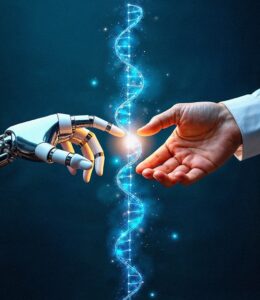
Artificial Intelligence (AI) in the 21st century, it has become a transformative force across industries. AI is rapidly transforming healthcare, introducing new ways to diagnose diseases, personalize treatments, streamline operations, and improve patient outcomes. By combining vast amounts of medical data with advanced computational techniques, AI is reshaping the landscape of medicine. In this article we discuss the current applications, benefits, challenges, and the future trajectory of Artificial Intelligence (AI) in healthcare.
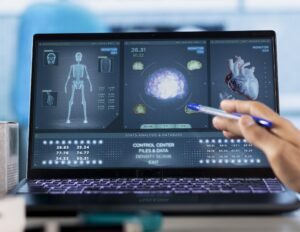
Role of Artificial Intelligence (AI) in Healthcare
AI technologies can analyze complex datasets, recognize patterns, and support clinical decision-making. It is essential to understand the key role of AI technologies:
- Machine Learning: In healthcare, Machine Learning analyzes electronic health records, lab results, and imaging data.
- Natural Language Processing: Natural Language Processing is used to transcribe patient-doctor conversations, and extract insights from unstructured data.
- Computer vision: Allows AI to interpret visual data, critical for radiology, pathology, and dermatology.
- Deep Learning: DL using neural networks with many layers for pattern recognition, especially in medical imaging like CT scans, MRIs and X-rays etc.
- Robotic Process Automation: This concept automates administrative tasks like scheduling, billing, and claims processing.
Major Applications of Artificial Intelligence (AI) in Healthcare
-
Diagnosis & Imaging of Medical
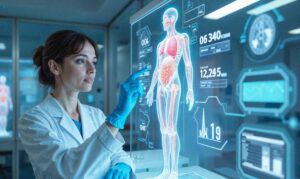
The most valuable work of AI is Medical Imaging such as MRIs, CT scans and X-rays. AI algorithms, can analyze radiology images faster and often more accurately than human radiologists, and detects abnormalities like tumors, fractures, or internal bleeding with remarkable accuracy. AI models trained on thousands of radiology images can identify early-stage lung cancer far earlier than traditional methods.
- Early detection of diseases like cancer
- Reduced diagnostic errors
- Faster analysis compared to human radiologists
-
Drug Discovery
Traditional drug discovery is often slow, expensive, and more chances to failure but AI is revolutionize this process. AI predicts how a drug will behave in the human body, reducing the need for early-stage animal trials.
- Predicting molecular interactions
- Identifying potential drug candidates
- Simulating clinical trials
During the COVID-19 pandemic, AI tools played a crucial role in vaccine and drug research.
-
Personalized Medicine and Treatment
Artificial Intelligence enables precision medicine to individual patients by integrating their genetics, lifestyle, and medical history. AI predicts how a patient will metabolize a drug based on their genetic makeup, reducing adverse drug reactions. This approach is especially valuable in oncology, where treatments vary widely depending on genetic mutations.
-
Predictive Analytics
Artificial Intelligence systems analyze patient data to predict health risks before symptoms become severe.AI predict early cardiac arrest or sepsis hours before clinical recognition, saving lives. AI-powered apps predict asthma attacks or diabetic history by analyzing data from patient-reported outcomes. Hospitals use predictive analytics to allocate resources more efficiently and prevent complications.
-
Virtual Health Assistants and Chatbots
AI-driven conversational agents are improving patient engagement and manage their health outside hospitals. There are many AI apps available for Symptom checking, mental health Support and many other functions. Virtual assistants remind patients to take medications, answer questions about side effects, and log reminders. These tools improve accessibility and reduce the burden on healthcare professionals.
-
Administrative Workflow Automation
Healthcare systems waste billions of dollars annually on manual administrative tasks, but now there are many tools available for automated work such as Appointment scheduling, Medical coding and billing and prior authorization.
Benefits of Artificial Intelligence (AI) in Healthcare
- AI reduces human error by analyzing large datasets with consistency and accuracy.
- AI can analyze medical imaging in seconds, while radiologist might take minutes to understand, this speed saves times for health workers and makes AI time efficient.
- AI can done administrative tasks automated, early diagnosis and optimized workflows reduce unnecessary tests and hospital stays that saves much cost.
- Faster diagnosis, personalized treatments, and continuous monitoring lead to improved overall health outcomes.
Challenges & Risks of AI in Healthcare
- Healthcare data is highly sensitive such as patient personal information, medical reports and medical history. AI systems must follow strict privacy rules and regulations to protect patient data.
- If AI model training is leaning then AI systems can produce inaccurate results or unequal across various populations.
- If AI systems makes a mistake then who is responsible for this? The hospital, the software developer or the doctor.
- Governments and organizations are still developing frameworks to regulate AI use in healthcare safely.
The future of AI Healthcare
- AI that passively listens to patient-doctor conversations and automatically writes clinical notes.
- AI-assisted robotic systems enhance surgical precision and Robotic systems augmented with AI for real-time guidance and tissue identification.
- Integration with wearable devices for real-time monitoring.
- The future of Artificial Intelligence (AI) in healthcare is promising and transformative.
Conclusion:
Basically Artificial Intelligence is not replacing healthcare professionals-it is enhancing working capabilities. When human physicians is supported by AI, they become more accurate, efficient, and compassionate—because they have more time to spend on the human aspects of care. While challenges remain, the continued advancement of AI promises a future where medical care is smarter, faster, and more accessible for everyone.
FAQS:
- What is the use of Artificial Intelligence (AI) in Healthcare?
AI in healthcare refers to the use of advanced technologies like machine learning and data analytics to assist in medical tasks such as diagnosis, treatment planning, and patient monitoring.
- How does AI improve medical diagnosis?
Artificial Intelligence (AI) improves diagnosis by analyzing medical images and patient data quickly and accurately.
- Can Artificial Intelligence (AI) replace doctors and nurses?
No, Artificial Intelligence (AI) is designed to assist to doctors and nurses. It helps healthcare professionals make better decisions by providing data-driven insights.
- What are the benefits of AI in Healthcare sector?
- Faster and more accurate diagnoses
- Personalized treatment plans
- Reduced healthcare costs
- Improved patient outcomes
- Efficient hospital management
- Is Artificial Intelligence (AI) safe in Healthcare?
Yes, AI systems can be safe when properly designed, tested, and regulated.
- Is AI good for analyzing Diagnosis & Imaging of Medical?
AI algorithms, can analyze radiology images faster and often more accurately than human radiologists, and detects abnormalities like tumors, fractures, or internal bleeding with remarkable accuracy.
- How AI work in Drug Discovery?
AI predicts how a drug will behave in the human body, reducing the need for early-stage animal trials.
- How Virtual Health Assistants works?
AI-driven conversational agents are improving patient engagement and manage their health outside hospitals. There are many AI apps available for Symptom checking, mental health Support and many other functions.
- How is AI used in hospitals today?
- Diagnosing diseases
- Managing patient records
- Predicting patient outcomes
- Assisting in surgeries
- Automating administrative tasks
- What is the future of AI in healthcare?
The future includes smarter diagnostics, AI-powered wearable devices, remote patient monitoring, and more advanced personalized treatments.